Many businesses spend money on digital marketing every month without taking the time to evaluate the digital marketing results properly. Sometimes, you’ll find yourself presented with a report containing all kinds of numbers, such as impressions and reach, but don’t let it deceive you, because those numbers don’t always mean sales. When your digital marketing strategy doesn’t give your organization a fair chance to measure its efficiency, you find yourself losing your budget on something that may look great on paper, but disappointingly does nothing for your growth.
Analyzing or testing your digital marketing is not simply an exercise in taking a quick look at a few charts and pretending that’s the end of it. Rather, it’s an exercise in taking the time to roll up your sleeves and get down to brass tacks and figuring out where exactly your money is being spent and what exactly you’re getting in return. And when you do that, what you realize is that it’s not necessarily an exercise in taking a look at all the pretty numbers that don’t necessarily add up to anything in the real world. Rather, it’s an exercise in trying to identify what actually works in helping to drive sales to your business.
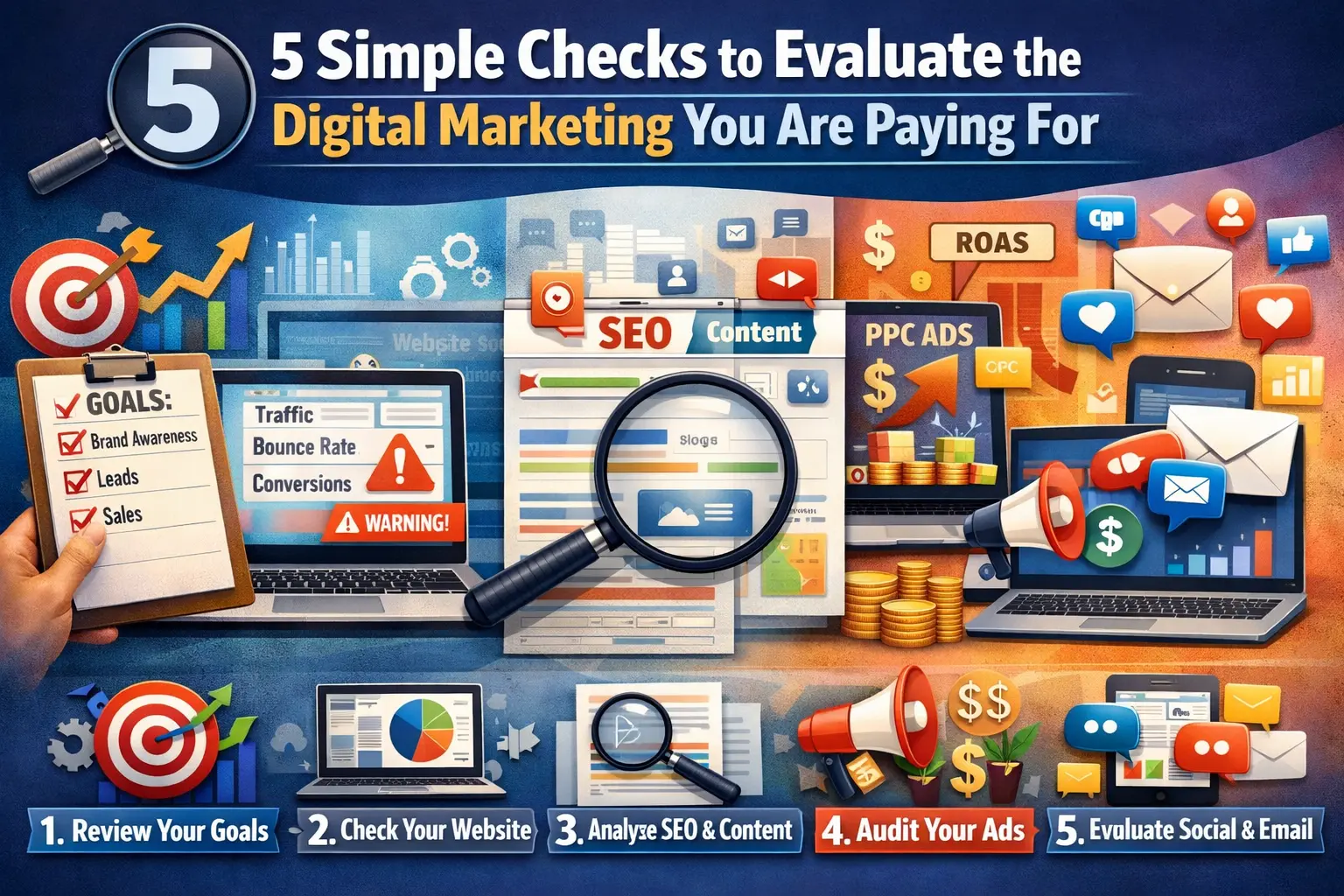
Here are five simple tests you can use to evaluate the digital marketing you are spending money on, so you can clearly see what is working, what is not, and where your budget is actually going.
1. Revisit the Basics – What are You Actually Trying to Achieve?
Before even thinking about the data itself, there’s a prerequisite understanding of what you want to get out of it. Otherwise, you’re wasting your time.
Are you after brand awareness? Lead generation? Or straight up e-commerce sales? Your marketing goals should tie in tightly with your overall business objectives. If your business desperately needs to start bringing in revenue, but the marketing agency you’re paying is all about growing your Instagram following, you’ve got a problem.
Take a look at whether or not your current strategy is truly working in helping with revenue goals. Get clear on what success actually looks like for your brand – whether that’s a certain number of new clients or a certain percentage increase in online sales. Once you know that for sure, every other metric becomes a heck of a lot easier to make sense of.
2. Get Under the Hood of Your Website
Your website is the hub for all online activities you do as a business. If it’s not doing the job of conversion for you, then the whole process of marketing you are doing is just going for naught.
First of all, it’s a good idea to have a look at where exactly all these visitors are coming from – search engines, social media, or these paid advertisements that are posted all over the place. Knowing that is the first clue about where these channels are performing well. Next, take a look at visitor behavior – are they reading all the content you’ve got on site, or do they up and leave straight away? High bounce rates are usually a sign that there’s a problem with your ads promising one thing and your landing pages actually delivering something completely different.
And as for its technical functionality, if your site is slow or doesn’t play well with others in a mobile environment, it will simply drive your users nuts and keep you from ranking well. And then you have to look at conversion measurements. Are users really engaging with what you’re trying to have them do? Signing up or buying? If traffic is through the roof but conversions are basically zero, then your website is probably in need of some serious TLC
3. Take a Long, Hard Look at Your SEO and Content Efforts
SEO is a long game, but that doesn’t mean you won’t see any progress – and usually it’s not going to happen overnight. When you evaluate the digital marketing you put into organic search, focus on the trends and changes that build over time, rather than getting stuck on the occasional spike.
So, start by checking your organic traffic. Is it steadily growing? Are you ranking for keywords that matter in your business? Ranking for general information-type terms will drive visitors, but ranking for keywords with buying intent drives real revenue.
Examine the quality of your content when you evaluate the digital marketing behind it. Does it actually answer the questions your potential customers are firing off in Google? High-quality content builds trust and positions you as an authority. If your blog posts or landing pages feel thin or irrelevant, they are unlikely to satisfy user intent. In many cases, improving results means tightening your strategy or working with a professional seo service that focuses on content built to rank and convert.
Also, consider the true effectiveness of your content marketing. Are your blogs and videos driving leads? Your content really needs to walk visitors by the hand through every step of their journey – from the moment they first come across your brand, right on through until the moment they’re ready to make a purchase. And if all your content just sits in the background, failing to actually prompt anyone to take action on what you’re saying, then it’s high time to step back and really examine what you’re doing. Sometimes that means making some pretty drastic changes to your overall strategy, and making darn tootin’ sure it’s on track to actually drive real results.
4 Audit Your Paid Advertising Campaigns
Paid ads give you instant feedback – which is why they’re so easy to evaluate if you know what to look for.
Instead, set your sights on two important figures and track Cost Per Click, also known as CPC, and then finally Return on Ad Spend, also known as ROAS. It’s crucial that you know whether or not you have to pay the customer to get them. If so, well, then either you’re targeting the wrong people or your creative is simply not functioning properly. Perhaps it’s time to pay a little more attention to your targeting and ensure your ads are actually reaching people with a demonstrated need for your solution. Don’t waste your money on broad targeting – that just burns budget for no return. Narrowing down your audience often leads to far better results.
And then, of course, there’s the landing page itself. Even in the presence of the best advertisement, it is ineffective if it directs visitors to a substandard page with poor conversion results. Ensure your ads are linking to your page with matching copy and making it simple for visitors to navigate their way to a purchase.
5 Assess Social Media and Email Effectiveness
Social media and email marketing are two of the most powerful marketing tools available today, especially for reaching and retaining customers.
For social media, don’t get caught up in the number of followers. The test of people’s liking, really, for what you’re doing is when they like, share, comment on, and save your posts. If they are, then you’re doing the right thing. The same applies to email marketing. Whether or not people are engaged in what you’re doing is what matters. Whether it be rubbish subject lines, whether the content or offer isn’t compelling, that’s what needs to be worked on. Then, of course, there is the problem of the quality of the lists, ensuring that the emails that go out to the masses are to people involved in the emails and the business. Just mass emails to people not involved in the business would be disastrous to deliverability. List sorting is important, ensuring that the message gets to the right person at the right time.
Turn Your Strengths and Weaknesses Into Action
So, having gone through these checks, you will then have a bloody clean idea about your position as well. This will help you understand how things are working and where you are blowing your budget.
Maybe your SEO’s a complete rockstar, but your ad budget’s just setting money on fire. Or maybe your website traffic’s through the roof, but your sales aren’t even close to keeping up. Either way, being in the know about this kind of information gives you the ability to make educated decisions about where you should allocate your budget and what you should prioritize. This might mean offsetting one expenditure for another and reducing spending in areas that aren’t contributing much to sales. Use this data to plan some tests and optimizations. Set some benchmarks so you’re able to see the progress over time and how things are really working, and where things could use a little polishing.
Making Evaluation a Habit
Checking in with your digital marketing plan will never be a one-time deal. This is because the internet world is a constantly changing place, meaning that what you are doing right at the present time will be rendered obsolete sooner rather than later. By implementing these five checks, you will be able to check in on what’s happening and get right back on track, meaning that success in the internet world all lies in checking in.